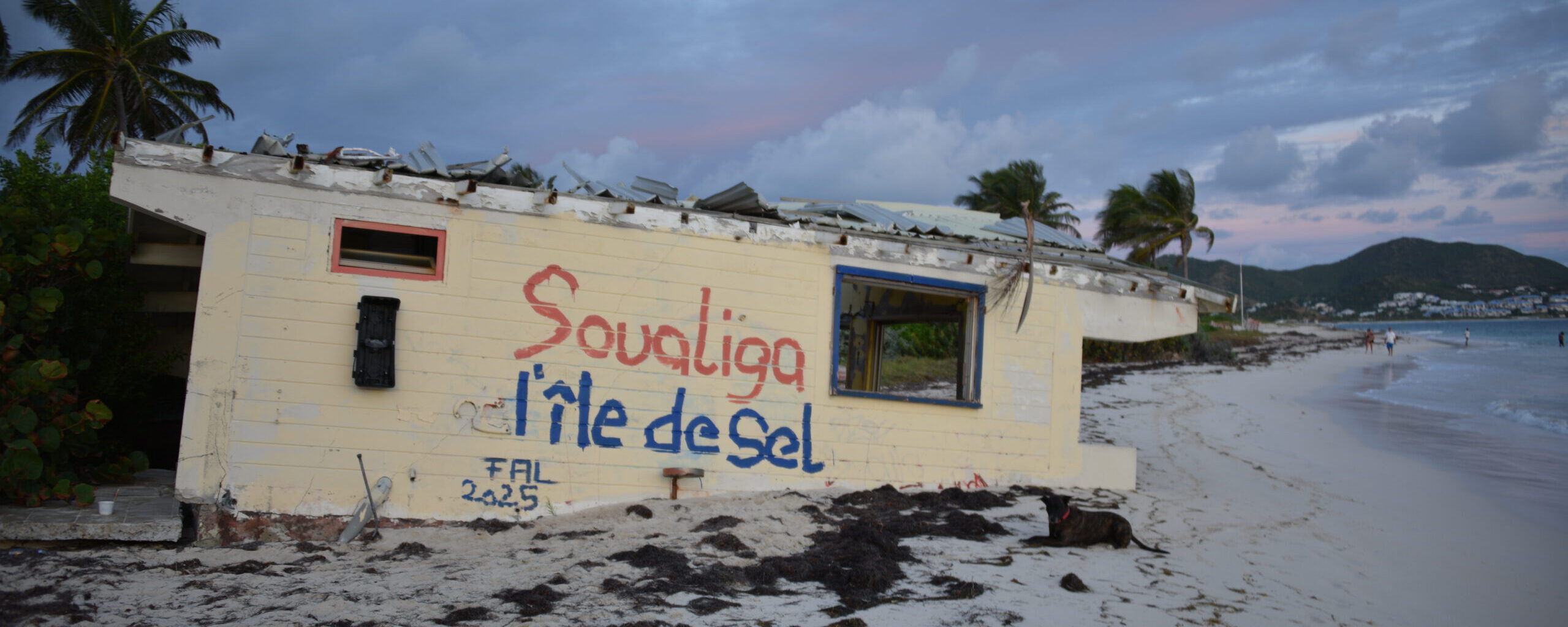
Soualiga: The Land of Salt
Long before Europeans arrived, the Arawak people who lived on the island called it Soualiga — « land of salt. » Salt formed naturally in the island’s shallow coastal ponds, and the Arawak harvested it for their own use long before colonization began. The natural conditions that made this possible — hot sun, low rainfall, and shallow lagoons where seawater could evaporate — would later turn the island into one of the Caribbean’s most important salt producers.
Colonial Rivalry Over « White Gold »
European interest in Saint-Martin’s salt began in the early 17th century. French settlers arrived on the island around 1629, and the Dutch followed shortly after, drawn by reports of the island’s Great Salt Pond. For European powers of the era, salt wasn’t a luxury — it was essential for preserving meat and fish on long ocean voyages and for provisioning colonies before refrigeration existed. The Dutch, cut off from Portuguese salt supplies during their war with Spain, especially needed a new source, and Saint-Martin’s salt ponds offered exactly that.
This shared interest led to an unusual arrangement. Rather than fighting endlessly over the island, the French and Dutch divided it in 1648 under the Treaty of Concordia — one of the oldest peaceful border-sharing agreements in the world. Notably, the treaty specified that salt pans should remain accessible to residents of both sides, reflecting just how central salt was to daily survival on the island.
The Industrial Era
Salt production remained modest for nearly a century after the treaty. That changed in 1733, when Commander John Philips, a Scottish-born officer in Dutch service, founded the settlement of Philipsburg — deliberately sited on the sandbar between Great Bay and the Great Salt Pond so that salt could move efficiently from pans to ships. Philips is credited with transforming salt harvesting from a small-scale activity into an organized industry.
On the French side, the main production centers were around Grand Case, the Étang de Chevrise, Quartier d’Orléans, and the Salines d’Orient. Salt was raked from the ponds, filtered through baskets to remove impurities, ferried ashore in flat-bottomed boats, dried, bagged, and shipped — much of it to North America and Newfoundland, where it was used to cure codfish.
The industry reached its height around 1850, when the island produced more than 330,000 barrels of salt a year, and roughly a third of the population depended on the trade for their livelihood. This labor was overwhelmingly performed by enslaved people until abolition in 1848, and by low-paid laborers afterward — the salt trade’s prosperity came at enormous human cost. Infrastructure expanded to match the industry’s scale: a drainage canal was built in 1852, and a steam-powered pumping station followed in 1862.
Decline and the End of an Industry
After the 1850 peak, the salt trade began a slow decline as industrial salt production methods elsewhere made Saint-Martin’s labor-intensive harvest less competitive. The two World Wars, which disrupted Caribbean shipping, accelerated the downturn. Production on the Dutch side wound down by the late 1940s, while French-side production in areas like Grand Case and the Salines d’Orient continued in smaller form for a few more decades before ceasing entirely by the 1960s.
What Remains Today
Traces of the salt era are still visible across the island. In Philipsburg, remnants of the Great Salt Pond’s stone salt-pan walls, the Rolandus Canal, a former salt warehouse, and the Salt Pickers Monument commemorate the industry’s laborers. In Grand Case, the town square still holds a salt grinder from the period. Several ponds, including Chevrise, still produce a dusting of natural salt in dry weather — a quiet echo of the industry that once shaped the island’s economy, its settlements, and its name.
Sources consulted: St-Martin.org, Soualiga Online, Les Fruits de Mer, Visit St. Maarten, and the Caribbean Birding Trail.